Before I dive into this piece, I would like to bring up some facts to keep in mind and reflect on later:
- 98% of employees feel disengaged when their managers give little to no feedback.
- Organisations that drive a culture of regular feedback have seen a reduction in employee turnover by about 15%.
- 43% of the high potential employees across organisations seek feedback at least once a week.
- 65% of highly engaged employees proactively seek repeated feedback.
(Source: All Things Talent, 2018)
A look at the above statistics would make you think that a culture of feedback is the common thread across most organisations. It doesn’t take much, after all. But the reality, however, is very different.
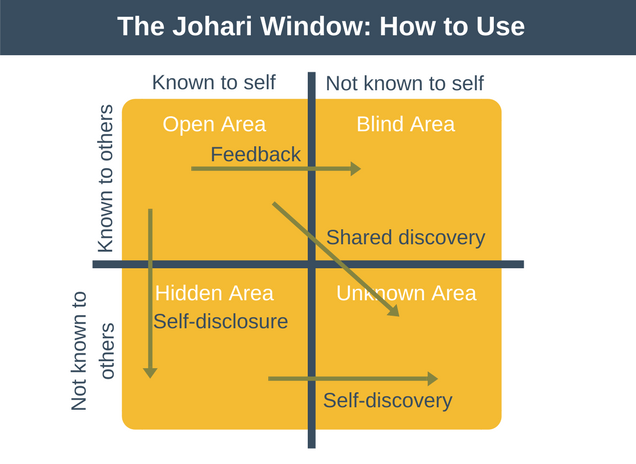
Let us take a look at feedback as an ‘exercise’, through the framework set by Johari Window, Luft & Harrington (1955). We find that the quadrant called the “Blind Self” is made up of things that others know about us, but we are unaware of. This awareness comes to the surface through regular and effective feedback. Although feedback is not the solution to all employee concerns (such as attrition, disengagement, productivity, etc.), it is a powerful and effective tool to diagnose the possible root cause behind these troubles. With the added caveat, this process is built in a manner that is bound to benefit the recipient at its nucleus.
Why does building a culture of feedback help?
- Invoking change as a necessity: Like an alarm, a conversation that is aimed at providing constructive feedback urges the recipient to wake up from their slumber and develop in areas that make them a better professional to work with.
- Healthier working and interpersonal relationships: Exchanging feedback often brings underlying tensions and conflicts to light, therefore, creating room for mutually beneficial resolutions and a better work environment. Regular feedback becomes particularly useful here as it nips the tension in the bud, thus preventing it from snowballing into a major disconnect.
- Creating a sense of purpose: The exchange of feedback creates a sense of being valued, as well as feelings of belongingness amongst employees. It satiates the fundamental human needs for recognition and appreciation. While positive feedback motivates, a negative one spurs employees to perform better. Essentially, this caters to the physiological level in Abraham Maslow’s ‘Hierarchy of Needs.’
- Developing ‘Listening’ as a skill: Feedback as an exercise relies on the fundamental act of effective listening that manifests itself in various forms across organisations, such as performance appraisal, employee pulse surveys, training effectiveness and evaluations.
Just like a double-edged sword, feedback can become detrimental if it is not used with the correct intent. That is why organisations should invest time and effort in raising awareness about giving feedback in the right way. A feedback conversation could have a negative impact if not done well and with due attention.
What do you keep in mind when exchanging feedback?
- Say bye to biases: The Recency Effect, Halo Effect, Familiarity Effect and Central Tendency Bias are only some of the many biases that a feedback-giver may fall prey to.
- Choose objectivity over subjectivity: The problem in the individual should be addressed and not the individual himself. As a feedback-giver, it is imperative that you acknowledge the fine line between an individual and their area of improvement. The feedback should be about those specific areas and not about the individual. Supporting the feedback with relevant past instances often helps.
- Have a conversation & not a monologue: An effective feedback conversation should always be a two-way conversation with enough space for agreement and dissent. Quite often, such conversations end up becoming one-way monologues on the part of the feedback-giver. A common but effective hack to avoid this would be to start by asking the recipient what they thought about their performance in the last quarter/half-year/year etc.
- Offer support: As a feedback giver, the individual’s responsibility is to identify and highlight the areas of development and offer possible support options that will help them improve. Some homework by the feedback-giver on the topics of relevant courses, fellow colleagues who can be mentors to the recipient may come in handy.
What is also worth highlighting is how feedback as a word is used with a negative connotation. Despite the essential precursors of ‘positive’ and ‘negative’; ‘feedback’ as a solitary word often induces a sense of fear, unwarranted anxiety and tension among those at the receiving end. At Godrej Housing Finance (GHF), we are taking baby steps towards destigmatizing this sentiment and making constructive feedback a part of our culture/DNA. To create a lean, egalitarian and high-performing organisation that is in line with our core beliefs of transparency and being bold, we are urging feedback to be known by the name of the feedback-giver to enable healthy debates, discussions, and eventual resolutions. Our performance management system enables managers to seek feedback about a reportees’ performance on a particular project from anyone in the company. This makes feedback specific to a goal and helps create self-awareness among individuals. Moving beyond the managers, our feedback mechanism also involves peer reviews. This makes the process well-rounded and authentic and makes the recipient more receptive to change and advice.
I would strongly recommend that if you haven’t already blocked your manager’s/reportee’s calendars for a quick feedback session, remember – the first step to develop is to identify the areas to develop on, through effective feedback.
 Ruhie Pande